
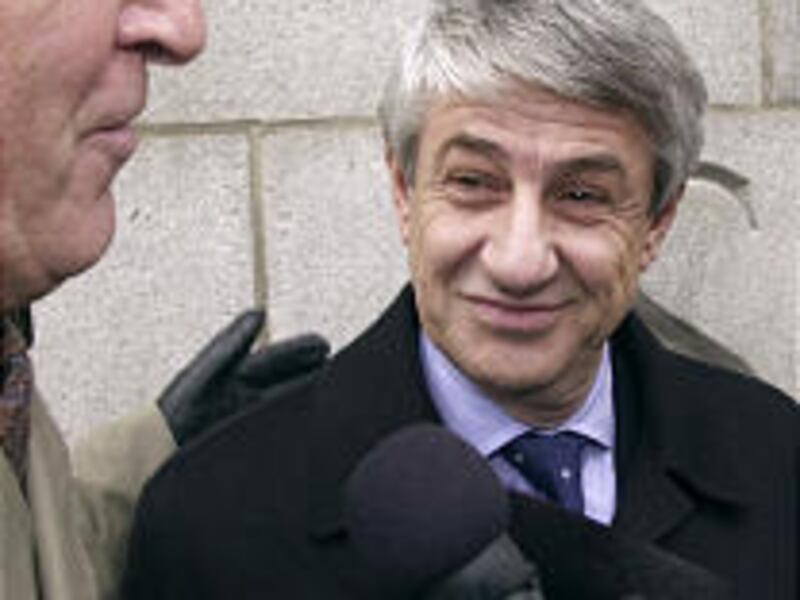

The immigrant owner of an Olympic hospitality company, who made $7 million from the 2002 Winter Games, testified Tuesday he never questioned why Salt Lake bid leaders Tom Welch and Dave Johnson wanted a contribution from him paid in cash.
"I said, 'Absolutely. Just give me time to assemble the cash,' " Sead Dizdarevic, owner of Jet Set Sports, said, describing envelopes of money totaling $130,000 that were delivered to Welch and Johnson at airports and hotels.
The four payments, made in the year before the International Olympic Committee's June 1995 decision to give Salt Lake City the Games, weren't the only transactions between Dizdarevic and the bid leaders.
Two checks that added up to $45,000 went from the bid committee to a Dizdarevic company called OL-CAL, set up in Canada to handle business from the 1988 Winter Games in Calgary. Dizdarevic said he wasn't owed any money by the bid.
So was he surprised when Welch turned up with one of the checks at a hotel during the 1994 Winter Games in Lillehammer, Norway?
"In a way, maybe yes, maybe no," he told the jury.
Dizdarevic said he assumed the money was meant as a "thank-you" for hospitality services he'd provided at no or reduced charges to the bid committee. Since the 1984 Winter Games in his native Yugoslavia, he has made his living selling travel packages to the Olympics.
Jet Set Sports, now based in New Jersey, was an official sponsor of the 2002 Games. It cost companies sending customers and employees to the Games between $800,000 and $2 million for hotel rooms, transportation, meals and Olympic tickets, Dizdarevic said.
He was given immunity by the government for his testimony against Welch and Johnson, who are charged with fraud, conspiracy and racketeering in connection with the more than $1 million in cash and gifts given to influence IOC members.
The government charged that Welch and Johnson conspired to solicit the payments from Dizdarevic in cash so the transaction would not appear on the bid committee's books and "could be diverted by the defendants for their own personal purposes."
During Tuesday's testimony, it was not made clear what those purposes were, although the prosecution seemed to be suggesting that the payment to OL-CAL was a way of laundering money later returned as cash.
Welch's attorney, Bill Taylor, dismissed that idea to reporters outside the courtroom. He said cash was necessary to people traveling as much as Welch and Johnson did during the bid.
"This is a cash-intensive business and operation," Taylor said. "They had to carry cash. It's not sinister. It's not suspicious. It's just the way you have to operate (especially in Africa and Eastern Europe). It's a different world."
The defense attempted to show that it was Dizdarevic who wanted to make the payments in cash out of concern that his dealings with the Salt Lake bid would have hurt his business had another city competing for the 2002 Games won.
Dizdarevic, however, said he didn't care.
"There would be no backlash," he said. "I am certain."
He said he could have written the bid leaders a check, but they wanted cash.
"I would oblige any request. It was as simple as that," he said.
Blair Brown, one of Welch's attorneys, pointed out a number of checks that had been altered to describe their purpose on the memo line as "Sead loan" instead of the original "SLC."
Dizdarevic had no explanation for the alteration, nor did his sister-in-law, Maria Jedrejcic, who also testified Tuesday under a grant of immunity. As the managing director of Dizdarevic's company, she wrote some of the checks that were cashed.
She also delivered two envelopes of cash — one filled with $35,000 to Johnson, who was parked outside a Salt Lake City International Airport terminal in August 1994, and another containing $44,000 to Welch as he changed flights at JFK International Airport in New York City in May 1995.
The delivery to Welch also included what Dizdarevic described as painkilling drugs for a longtime friend, an IOC member in Yugoslavia stricken with leukemia. Welch had agreed to give him the medicine on his last trip overseas before the IOC vote.
Dizdarevic himself handed over the other two money-filled envelopes: Johnson received $17,000 from him at a Nashville hotel in November 1994, and Welch accepted $35,000 at a hotel in Atlanta.
Earlier Tuesday, former U.S. Olympic Committee official Alfredo LaMont concluded his testimony despite nearly becoming sick on the stand. He told the jury he did not violate the terms of his plea bargain with the government by submitting a false tax return.
"We filed a truthful, complete and honest return in 2001," LaMont said.
In 2000, he pleaded guilty to two tax felonies related to the case and agreed to cooperate with the government in the hopes of reducing his sentence.
After a break for the Thanksgiving holiday, the trial will resume Monday.
E-mail: lisa@desnews.com