
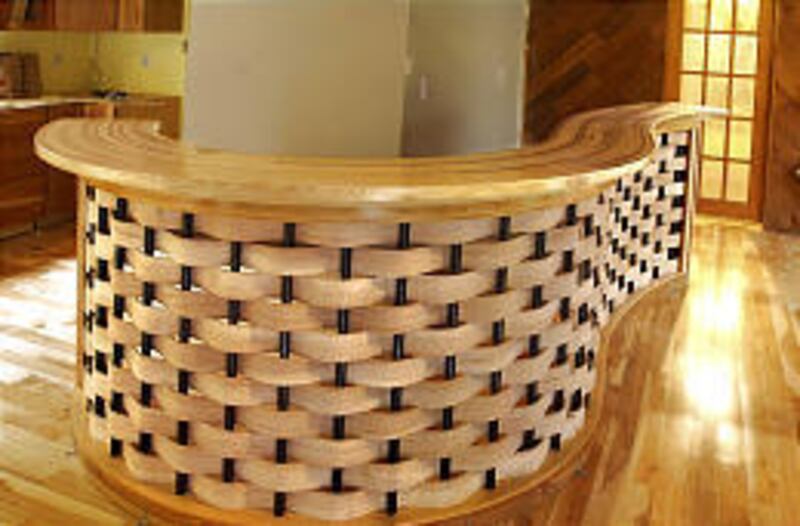

Chris Mroz imagines and tinkers in a secluded workshop west of Gig Harbor, Wash. Using a Danish contraption he bought from a defunct mill in Maine, Mroz compresses then bends solid hardwoods into convulsive and mesmerizing shapes reminiscent of the twisted spoons bent by the mind of TV pop-psychic Uri Geller.
So far Mroz, 46, has two U.S. patents, one pending, on the architectural applications of his bent-wood creations and a registered trademark on his brand — Fluted Beams.
The world noticed.
The keepers of the historic Virginia home of James Madison, the fourth U.S. president, enlisted Mroz to duplicate in compressed oak the original curved frame parts of decorative windows around the front door.
Two sons of the inventor of the circa 1958 Cherner Chair, now in reproduction, hired Mroz to reimagine the curved walnut that serves as the chair's arms and back as one 7-foot-long piece of bent wood.
Replacing the red oak mast hoops of the historic naval sailing ship the USS Constitution frustrated craftsmen who used traditional steam-and-bend methods but recorded a breakage rate of more than 80 percent.
The mast hoop supplier for Old Ironsides in Charlestown, Mass., found Mroz could compress and bend replacement oak hoops without breaking them.
The latest big twist in the Mroz story comes courtesy of the enigmatic architect who designed the bent-metal Experience Music Project in Seattle, Frank Gehry.
A scout for Gehry Partners in Los Angeles paid an investigatory visit in September to the Mroz workshop.
Craig Hall, former co-owner of the Dallas Cowboys football team, bought vineyards and a winery in Napa Valley, Calif., in 2003. Hall commissioned Gehry to design a new winery and a visitor center slated to open in 2009. Gehry's sweeping design calls for glass-domed roofs topped with a massive woven, bentwood trellis reminiscent of a grape arbor.
The scout wanted to find out if Mroz could make the trellis with wood from his Danish press, the only one of its kind in the United States. The scouting report got back to Frank Weeks, a key member of the architecture team working on the Hall Winery project.
"I think his process is unique compared to other wood-bending people," Weeks said. "There's technical reasons and there's aesthetic reasons. What's interesting about it for us is he's able to bend wood, and it's solid all the way through rather than laminated. So you don't see the laminations."
Two other competitors working on the winery roof trellis use an industry standard lamination process that involves bending thin strips of fir or cedar and gluing them together.
But think about it. If you had millions to spend building a winery of Frank Gehry's design, would you want the most visible decorative element pieced together from slats of glued softwood? Or would you want it made of solid white oak, the same American oak used by coopers who construct aging casks for wine?
"We're still evaluating how the process is going to work for us in the end," Weeks said. "We like to keep some of these interesting fabricators in our back pocket."
Back in Gig Harbor, Mroz refuses to rest on his bent laurels.
"This is going to be a $50 million company in 10 years," he said.
As a 15-year-old, Mroz, the son of a career tool-and-die maker from near Toronto, took apart his father's slide projector and camera and put the pieces back together with a C-clamp, a curtain rod and sheets of wall paneling to make himself an enlarger so he could print his own black-and-white photographs.
When color photography first hit the mass market in the early 1970s, he mixed his own film-developing chemicals in the family bathroom and figured his career track would lead to photography.
By college, however, he tired of it and started his own stained-glass studio to pay the bills for his undergraduate studies in biology at the University of Guelph and his graduate studies in plant biochemistry at Blakehead University, both in Ontario. He later added an MBA from Touro University International in Cypress, Calif.
Mroz put that knowledge to work first in the pulp and paper industry, then made his fortune selling engineering and manufacturing software to marine and aerospace industries in Washington.
"The kind of software rocket scientists in the area would use to plot trajectories for sending stuff to Mars," Mroz said.
With his earnings, Mroz bought a yacht, then decided to build his own dinghy. To create part of the dinghy's curved support structure, he ordered compressed ash from a Maine mill, the same mill whose compressor he would later buy.
Mroz has since sold the yacht. But he keeps the dinghy suspended from the ceiling in part of the home he has converted into his workshop.
Mroz's home has morphed into a showcase for his creations — the fluted beams he engineered to hold up a floating staircase, the bentwood bar countertop, the floor panels and beams inlaid with artistic bent wood, the outdoor fluted concrete columns embedded with bent wood that hold up the porch roof.
Mroz has two employees, but he envisions having 40 to 100 Fluted Beams employees churning out compressed bent-wood products in cherry, oak, maple, beech, walnut and ash.
"My company is microscopic and under the radar right now," Mroz said. "I'd prefer to see it expand with my own creations. ... My best day is doing something new at the bench. I like to do something that nobody else in the world is doing."
Distributed by Scripps Howard News Service, shns.com.