

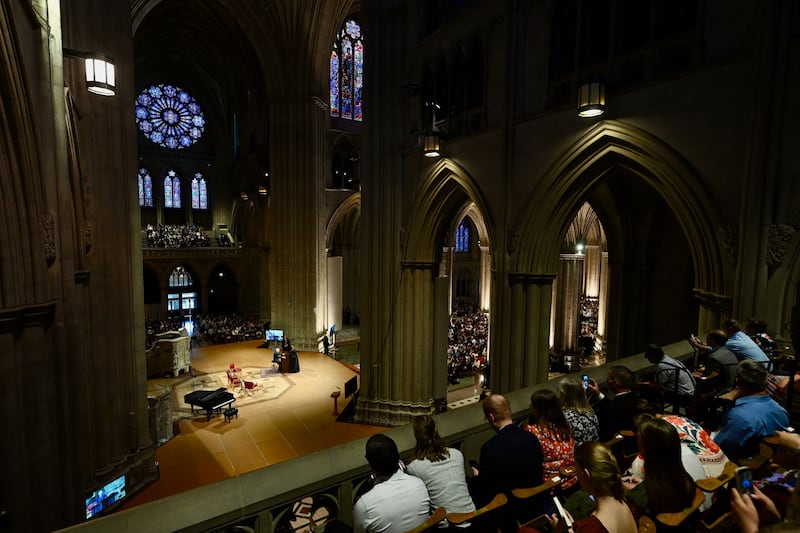

WASHINGTON, D.C. — Following seven decades as a student of the U.S. Constitution, President Dallin H. Oaks stood in the Washington National Cathedral on Wednesday, Sept. 16, and declared the need for common ground in preserving religious freedom.
“I have always regarded the United States Constitution as a model for a diverse people to achieve self-government,” President Oaks said on the eve of Constitution Day in the United States.
President Oaks, who was sustained as President of The Church of Jesus Christ of Latter-day Saints almost one year ago, in October 2025, has served as an apostle of Jesus Christ for 42 years. He was a law clerk to U.S. Supreme Court Chief Justice Earl Warren. He taught for 15 years as a professor of law. Immediately prior to his call in 1984 to serve as a member of the church’s Quorum of the Twelve Apostles, he served for more than three years as a justice on the Utah Supreme Court.
“I do not speak for any political party or pressure group,” he said as he began his remarks. “I speak for the United States Constitution.”
President Oaks shared some background of the first members of The Church of Jesus Christ of Latter-day Saints. He briefly explained their expulsion from Missouri in the 1830s and their subsequent move farther west — outside the borders of the United States — in the 1840s. He described the church’s pioneers at that time as refugees.
Those experiences, he said, helped early members of the church to learn what it meant to become peacemakers as they sought the ability to live their religious beliefs.
“We have become peacemakers and advocates of freedom and unity by necessity. We have learned to forge those compromises on policy necessary to achieve the freedom and unity to live at peace with those with whom we disagree on religious faith. At the same time, we have preserved the freedom required for us to continue with our most important doctrines and practices,” he said.
The United States at large has also had to adapt its laws from the country’s beginning 250 years ago, he said. Examples include extending the right to vote to women and abolishing slavery.
“New laws had to ensure that those who had been enslaved or disadvantaged would have all the conditions of freedom,” he said.
Members of The Church of Jesus Christ of Latter-day Saints have a specific reason for their deep appreciation for the Constitution of the United States, President Oaks said.
“We have a revelation that identifies the Constitution as divinely inspired. This does not mean that every word is inspired, but that it is based on inspired principles.”
President Oaks specifically mentioned five inspired principles:
- The source of government power is the citizens. This is often referred to as popular sovereignty.
- The division of delegated power between the nation and its states.
- The separation of powers among the executive, legislative and judicial branches.
- The “cluster of vital guarantees” of individuals’ rights and specific limits on government authority, such as in the Bill of Rights.
- The “vital purpose of the entire Constitution” that citizens are to be governed by law and not by individuals.
He added at the end of that list his hope that individuals would be loyal to the aspirations and the system of government over loyalty to individuals who are elected.
“Our loyalty is based on the Constitution and its principles and processes, not to particular officeholders,” he said.
The results of a society that seeks to abide by shared principles include the fact that groups and individuals work to understand each other while also working to compromise in ways that help everyone live together in peace, President Oaks said.
“As a practical basis for unity, all of us should accept the reality that we are fellow citizens who need each other. This requires all of us to obey some laws we dislike and to live peacefully with some persons whose values differ from our own. We should make every effort to understand the experiences and concerns of others, especially when they differ from our own.”
As individuals seek to protect rights that matter to them, President Oaks counseled against seeking “total dominance” on every position.
“Where there is genuine conflict on the effect of constitutional rights, contesting positions need to be balanced legally and negotiated politically in a way that upholds all essential rights to the greatest extent possible. We need to work for a better way forward — a way to resolve differences without compromising core values. We should seek fairness for all,” he said.
Part of this process includes individual reflection to understand what beliefs are truly nonnegotiable and which others may be lower in priority in protecting the general welfare of society.
“Far from being a weakness, reconciling adverse positions through respectful negotiation and coalitions is a virtue. As Jesus taught, ‘Blessed are the peacemakers; for they shall be called the children of God’ (Matthew 5:9).”
Creating and maintaining a peaceful society requires all to act in good faith, President Oaks said.
He continued by drawing on the teachings of the apostle Paul in Romans 12:18, where Paul invited the Romans to “live peaceably with all men” wherever possible.
“The Constitution compels a divided people to build coalitions to allow them to act together. ‘Compels’ is a strong word, but it is exactly what the Constitution does. It puts what we now call ‘peacemaking’ at the heart of the Constitution’s process for achieving freedom and unity, and fairness for all.”
That process, President Oaks said, includes parties sitting down with one another to share their opinions face to face. He said he finds it unfortunate that too many matters end up in litigation to find resolution. This puts the decision in the hands of courts and judges in a time-taking and money-depleting endeavor.
“When a contentious issue arises, one filled with major conflicts, we ought to see this as an opportunity to listen and to learn, both about the issues at hand and about those who differ from us.”
This approach is one President Oaks said will help achieve fairness for all without compromising core values on either side.
“Peacemaking involves finding common ground,” he said.
Some forms of peacemaking involve the inclusion of an arbiter. For example, an ecclesiastical leader may work with a couple seeking to resolve marital discord. Individuals who work to bring together groups with expressed differences and those who engage in service projects are also types of peacemakers.
“People of goodwill, compassion and a desire to understand and help one another are at the core of peacemaking and fairness for all in the constitutional process of achieving freedom and unity, as difficult and slow as it is. It is all about trying to understand the deep needs, the deep commitments, on both sides and then to forge solutions that yield peace and fairness for all.”
Members of The Church of Jesus Christ of Latter-day Saints believe each individual on earth is a literal son or daughter of heavenly parents and that God has a plan for them. This understanding, President Oaks said, should help them as they work to overcome conflict with others.
“Knowing that we are all children of God gives us a divine vision of the worth of all others and the will and ability to rise above prejudice and racism.”
In conclusion, President Oaks said he knows the process of becoming and acting as a peacemaker is not always easy. He said he knows Heavenly Father will bless those who work to bring peace to the world.
“He gave this command to love, and He promised His help as we seek to obey it.”
This is not the first time President Oaks has invited individuals to follow the example of the Savior and work to create a more peaceful world.
President Oaks spoke to members of the Church in the April 2026 general conference and taught listeners to “love even your enemies.”
In that message, he also noted that living peaceably and lovingly with others who do not share the same values or have the same covenant obligations can be a challenge.
“As followers of Christ, let us follow Him by forgoing contention and by using the language and methods of peacemakers. In our families and other personal relationships, let us avoid what is harsh and hateful,” he said.
In the October 2024 general conference, President Oaks, then the first counselor in the First Presidency of the Church, also spoke of peacemaking in efforts to stand for what is right when negotiating public policy.
“As we pursue our preferred policies in public actions, let us qualify for [the Savior’s] blessings by using the language and methods of peacemakers. In our families and other personal relationships, let us avoid what is harsh and hateful,” he said.