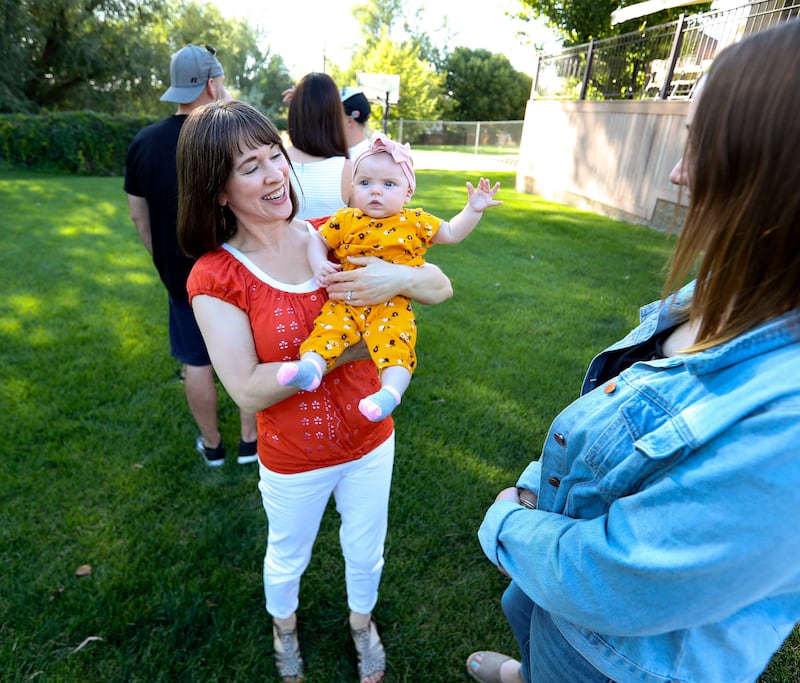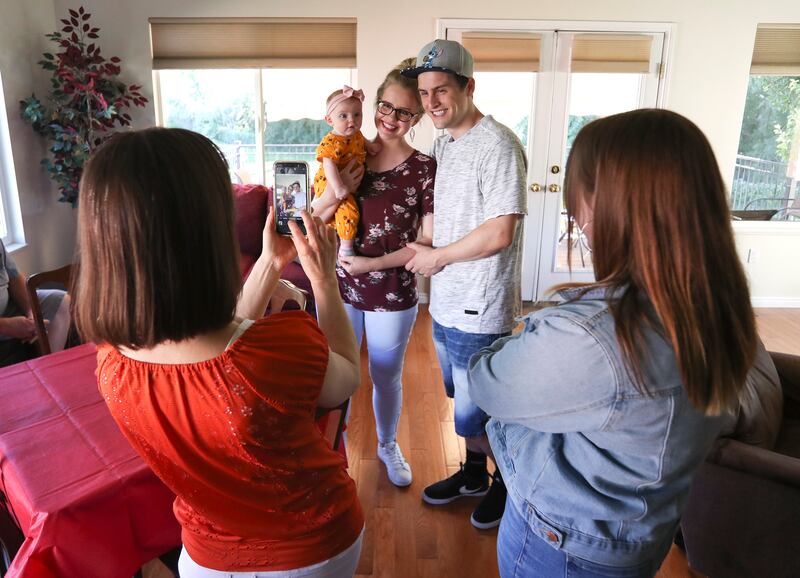

SALT LAKE CITY — Ask Leah and Clark Burbidge what they know about blending families and they tell you with both wonder and delight that between them, they have about 68 years of experience. Leah Burbidge grew up in a blended family. And when Clark Burbidge’s dad died 21 years ago, his mother remarried, creating a different version.
But it is their own blended brood — her five kids and his five kids — that has given them expertise in meshing families in a way that creates enduring relationships.
Blending their family in 2005 was both easier and more complicated because his children were mostly grown, while four of hers lived with them.
But when they die, the Burbidges say, they’re confident their children, who ranged from 4 to roughly 25, will still be friends. They don’t expect to face challenges some remarried couples do as they age, where children agree to care for just their parent, but not the unrelated spouse, forcing couples apart, for example.
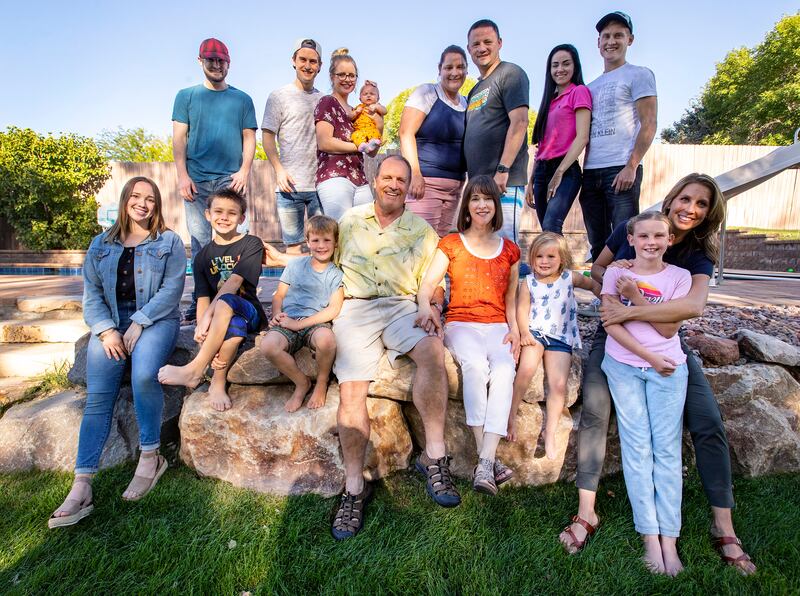
The couple, of Woods Cross, Utah, wrote “Living in the Family Blender: 10 Principles of a Successful Blended Family,” published in July. Now retired, Clark Burbidge worked in investment banking in California and Utah before becoming chief financial officer for several Utah companies. Leah Burbidge was primarily a stay-at-home mom.
They say blending all the elements of their lives into warm and workable relationships has felt at times like running a community center. And like a community center, it can be a ton of fun.
“With blended family, a lot of things you deal with are the same as any family, but there’s a fragile nature because of the drama and trauma and baggage that kids have and that parents have that they’ve been through. That makes every issue bigger or deeper or more challenging in many ways,” said Clark Burbidge.
Blended families are increasingly common in America. Though divorce rates have stabilized (except among older couples), an increasing number of couples are not married and more children live with a parent who is not biologically related. One Pew Research Center study said 4 in 10 adults have stepkin of some type. Using Census Bureau statistics, the Stepfamily Foundation reported that 1,300 new stepfamilies are forming every day.
The Deseret News asked the Burbidges how they’ve tackled keeping adult children connected, as well as other challenges. The interview has been edited for length and clarity.
Deseret News: What don’t people know about blending a family?
Clark Burbidge: People tend to focus only on minor children who are at home or having visitation back and forth or are affected directly. ... That’s really unfortunate, because adult children are affected in different ways but just as deeply. It’s really easy for a married son to just decide to check out and only have dealings with his parent.
I think there’s a deeper feeling between bio children, and that’s perfectly OK because they grew up together. But we also think connection exists and can be created with children who are stepchildren or half brothers. We have step- and half- and bio- and just about all the kinds they come in. We don’t think about our kids in terms of last names.

DN: How did you embrace the family as a whole across a range of ages?
CB: One thing we decided to do was to create new traditions as a family. Sometimes we pull from traditions the older kids were used to. They enjoy those. But we do things that are based on our own family experience now and that’s been wonderful for bonding.
Leah Burbidge: On the Fourth of July, we get fireworks and invite all the kids to join. We do treats. I guess that’s something families probably do anyway, but for us it was kind of a big deal. We also invited close friends to join.
Clark’s family has condos, so we are able to rent condos every year and go to Sun Valley. We’ve invited all our kids. Every year is a little different; sometimes some can’t go. We just invite everybody every year.

CB: We have an open table on Sundays for dinner. Anyone can come, bring any friend they want with them. We’ll have a large group sometimes of 20-somethings who are at school here and don’t have any family and we have had wonderful relationships with them. That’s part of our community center. We do family activities during the year. Thanksgiving and Christmas are really complex. We don’t ever have everybody here at the same time. Ever. We’re OK with that. Sometimes we open presents a couple of days after Christmas, or open them a week later when kids can come or we have Thanksgiving at a different time of the day or even a different day of the week so that kids can be accommodated.
That’s one of the things about blended families. You just can’t have everything be personal. If you can come, great. If you can’t, we love you.
DN: How do you form relationships with each non-bio child, especially older ones?
CB: I think one of the secrets of being with each child is figuring out where that child is from the very beginning. You can’t start where they’re supposed to be or where you think they are or where they should be based on their age. ... As you sit down with them, over time you learn who they are and where they are as a result of the divorces and separations and all the stuff that’s gone on, including suddenly a new family.
We’ve worked hard to recognize each of our children as individuals. All are at different points.
DN: What was the hardest part and how did you approach it?
LB: I think one of the main issues is disciplining, like when parents see things differently. We have an understanding that disciplining isn’t necessarily punishing; it’s more about teaching our children and helping them learn if maybe they made a bad choice. Definitely it has to be a united front as parents. I don’t think we went into our marriage and said, “OK, what’s our game plan here?” You kind of take it day by day and just deal with situations as they come up.
CB: We decided there would be no surprises. Our kids had been through three divorces between the two of us. That means they’d had their lives completely turned upside down. They were changing schools, being pulled out of every support and security mechanism that they’d had. And that had happened more than once — new everything. We made them part of the decisions. We brought them when we looked for the house. We talked about decisions we were making along the way when we were dating. Certainly there are times when it just has to be between the couple, but there’s a time when kids can be involved and get excited and take title to it.
DN: What’s the most important ingredient in a blended family?
LB: Being respectful — respect goes a long way when you have children. ... Children can feel whether you love them or not; they can tell by the way that you treat them.