

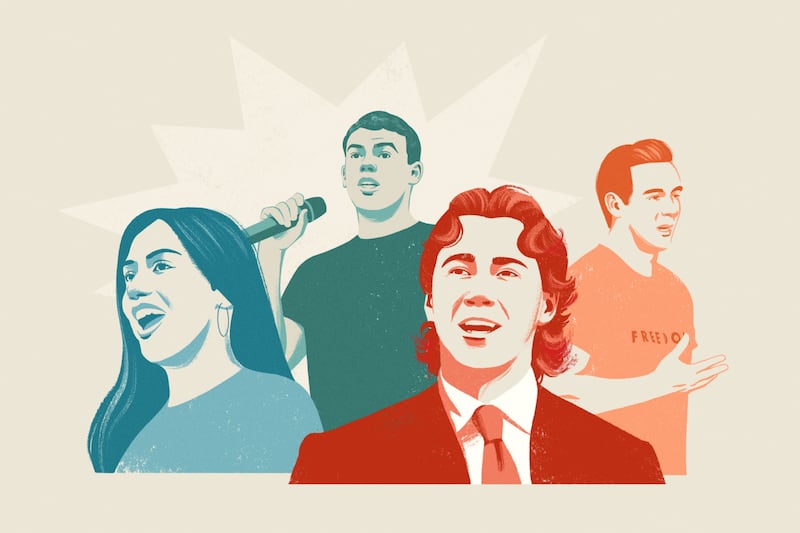

- A new poll found 55% of Gen Z voters agree with anti-Israel comments from Nick Fuentes and Michigan Rep. Rashida Tlaib.
- Voters who got their news from TikTok were much more likely to hold negative views toward American Jews.
- Utah Republicans have elevated Kai Schwemmer, who has made national headlines for his views on Fuentes and Israel.
Top Utah Republican Party leaders embraced a new generation of Gen Z political activists as the future of the conservative movement at a College Republicans event at the University of Utah last Friday.
Among the social media-savvy cohort on stage was one Kai Schwemmer.
Before the forum, congressional candidate Karianne Lisonbee posed with the 23-year-old influencer and aspiring politician. Afterward, U.S. Rep. Mike Kennedy joined him for dinner at the Alta Club in Salt Lake City.
Despite his warm reception, the up-and-coming star may represent a generational divide in U.S. politics.
Over the previous month, Schwemmer had been the subject of an online pressure campaign, and several national news articles, describing him as the face of a troubling trend among young GOP operatives.

At issue was Schwemmer’s past affiliation with white nationalist personality Nick Fuentes, his refusal to disavow the offensive commentator and his continued defense of his aggressive “America First” worldview.
Some conservative pundits accused Schwemmer of being an antisemite, a Nazi and a “Groyper” — the self-appointed title given to Fuentes’ supporters. Schwemmer rejected all of these labels outright.
But the charismatic Schwemmer readily admits that his brand of Gen Z politics — emphasizing group identity, U.S.-Israel relations and radical change — is eager to upset the status quo, starting in Utah.
On Friday, Schwemmer took the podium as a spokesperson for “young white men,” who he said had been ignored by elected officials focused too much on the GDP and not enough on protecting American values.
Schwemmer told the mostly college-age crowd to frame immigration restrictions and military restraint in terms of “love for Americans,” and to avoid the “spite and hate” that some in the media and government ascribed to them.
“We cannot allow ourselves to become the caricatures that they make us out to be,” Schwemmer said.
Nodding along, six rows back, was a well-dressed young man wearing an all-black Nick Fuentes hat. However, despite his self-described place on the “dissident right,” Schwemmer’s core message is surprisingly bipartisan among young voters.
In what some see as the fulfillment of the so-called “horseshoe theory,” Gen Z activists on the political left and political right find themselves in broad agreement on distrust toward democratic institutions and disdain for Israel.
Research points to factors like the cost of living, uncertain job markets and online news consumption that push young people on both sides of the political spectrum to agree on certain issues.
Other political observers view Gen Z actors like Schwemmer as a harbinger of a populist wave that somehow always carries with it a conspiratorial attention to, and very real threat for, the Jewish people.
Who is Kai Schwemmer?
Since launching his social media presence in 2020 at the age of 17, Schwemmer has slowly accumulated tens of thousands of followers across platforms like TikTok, Instagram and X. But recently this has accelerated.
His performance on popular YouTube debate shows, collaboration with state GOP officials on a ballot initiative and appearance at the State of the Union as U.S. Rep. Burgess Owens’ special guest helped to raise his profile.
The momentum increased when Schwemmer, who was already serving as field director for the Utah Federation of College Republicans, was appointed as the political director of their national counterpart on March 5.
But his trajectory has made Schwemmer a flashpoint for the escalating tensions within conservatism over Gen Z.
On March 6, Joel Berry, the former editor of conservative satire outlet The Babylon Bee, and author James Lindsay, singled out Schwemmer as the latest example of groyper infiltration of college Republican organizations.
Years-old clips resurfaced of Schwemmer meeting with Fuentes at his America First Political Action Conference, defending Fuentes from criticisms and signaling support for his views on Jewish influence in American politics.
Fuentes has become synonymous with the online far right — a description he applies to himself — preaching the superiority of white, male, Christian identity at the expense of other ethnic and religious groups.
Often in much harsher terms, Fuentes consistently tells his followers that “organized Jewry” is the “main challenge” to American success and that “Jewishness” is the “common denominator” of America’s setbacks.
Schwemmer eventually responded in a post saying his past comments in support of Fuentes did not necessarily reflect his current views. He condemned “all forms of hatred, including antisemitism” and denied being a “groyper.”
The Highland High School graduate credited a mission for The Church of Jesus Christ of Latter-day Saints in Argentina with helping him to grow. Schwemmer is currently studying political science at Brigham Young University.
In multiple interviews with the Deseret News, Schwemmer staked out his position on the right.
Implementing mass deportations and limiting legal pathways for immigrants are priorities for Schwemmer, who said that Fuentes is who first introduced him to concerns about American demographic change.
Schwemmer describes himself in opposition to libertarians, preferring protectionist economic regulations to strengthen domestic industries and policies that promote two-parent households.
In December, Schwemmer acknowledged there is still “definitely overlap” between his views and Fuentes’.
While he said he opposes hateful discrimination, Schwemmer said it is “particularly difficult in the case of Jewish people” to know if they align with the country’s best interests because their identity can be tied to the land of Israel.
In an April interview, Schwemmer rejected that any of his views are “antisemitic.” He does not attribute “dual loyalty” to every Jew, but he said that Judaism “has been expanded to include a political project, which is Zionism.”
Zionism is the belief that Jewish people have a right to self-determination in their ancestral homeland, according to the Jewish Center for Justice.
“There do seem to be cases where this kind of personal identifier supersedes the American interest,” Schwemmer said. “And I don’t see a reason for anybody in the United States to have an identifier, that is not their religion or their family, that would supersede the nation’s will.”
Where do you draw the line?
James Lindsay, who authored several books criticizing “woke” identity politics on the left, and now focuses on similar trends on the right, believes Schwemmer’s willingness to tolerate Fuentes indicates a disturbing shift.
The assassination of Charlie Kirk in Utah appears to have been a catalyst, according to Lindsay, opening the door for popular conservative voices like Tucker Carlson to host Fuentes and increasingly to adopt his talking points.
Meanwhile, College Republicans have been embroiled in controversies over racist comments in group chats. But whereas these could be dismissed as kids making bad jokes, Schwemmer has direct ties to Fuentes, Lindsay said.
“So people are using his appointment to this role to say, ‘Enough is enough. What’s going on? We’re not losing our party to Nick Fuentes,’” Lindsay told the Deseret News. “Once you break a taboo it’s very hard to come back.”
A political movement is meaningless unless it can cut out the “fringes,” Lindsay said. Instead of the GOP establishment trying to appear in touch with these kinds of Gen Z influencers, they should draw the line, he said.
This is something Kirk did well, according to conservative columnist Bethany Mandel. As he worked to maintain Trump’s MAGA coalition, the Turning Point USA founder famously prevented Fuentes from attending his events.
As a Jew, Mandel said she cannot share a “tent” with someone like Schwemmer. It is up to personalities like Ben Shapiro, and groups like Turning Point, to continue “gatekeeping” those associated with Fuentes, she said.
As someone who has been posting provocative political takes since high school, Schwemmer is no stranger to backlash. But he believes the reaction to his position at College Republicans of America has been “ridiculous.”
He said, during an interview with the Deseret News, that instead of trying to have conversations with him, people like Berry and Lindsay have mischaracterized his views, contributing to vitriol from the right and violent threats from the left.
While he said he has attempted to distance himself from Fuentes since returning from his mission last year, Schwemmer refuses to condemn him because he believes that the demands for him to do so are insincere.
“There are certain anxieties that people have that preclude them from being able to engage in these questions in good faith,” he said. “It causes them to do things that are counterproductive. And that’s the attempt to cancel people.”
Schwemmer said he does not believe his “America First” ideology is at conflict with his Christian faith. It reflects a “sincerely held love for the nation,” he said, but does not require “any kind of racial or ethnic supremacy.”
Down the rabbit hole
Unlike the various strands of “Make America Great Again,” the “America First coalition,” is not united by President Donald Trump, according to Stryder Bigler, who helps promote Gen Z conservative influencers.
The uneasy alliance between personalities like Fuentes, Carlson and Candace Owens centers around an “anti-war movement” sparked by Israel’s war in Gaza and accelerated by Trump’s actions in Iran, Bigler said.
Born in 2005, the 21-year-old founder of Off The Record Media said his generation grew up amid endless quagmires in the Middle East which appeared to come at the expense of politicians addressing domestic needs.
Increasingly, Gen Z believes “the root cause of all these issues that America gets dragged into is Israel,” he said.
On this point Bigler recognizes significant overlap between the “far right and far left.” The “horseshoe theory” has some holes, but on Israeli influence and pro-Palestinian rhetoric, Bigler thinks it is spot on.
For many, the turn against Israel begins with an internet rabbit hole, Bigler said. But often it goes deeper.
“I have seen a lot of people that start on this issue, start researching it, slowly become pretty obsessed with it,” said Bigler, who studies journalism at Arizona State University. “And I do see antisemitism grow in some of those people.”

During the 2024 election, Utah Valley University student Jeb Jacobi considered himself “fully on the MAGA train.” But as he researched Trump’s connection to disgraced financier Jeffrey Epstein, Jacobi considered jumping off.
After Kirk’s killing at UVU, Jacobi, age 22, dove into content from Carlson, Owens and Fuentes about Kirk’s alleged evolution on Israel and about pro-Israel lobbying in the U.S. He emerged a total skeptic of both Israel and Trump.
He concluded the politician who had resurrected the 80-year-old phrase “America First” had done the opposite.
“There’s a lot of people in America that are suffering,” Jacobi told the Deseret News. “And unfortunately, the Trump administration has chosen to put the Israeli war over actual citizens who need health care and actual support in this country.”
Like his ideological opposites on the left, Jacobi believes there’s a difference between his “anti-Zionism” and antisemitism. It is not antisemitic, Jacobi says, to track AIPAC donations to Congress and federal policies that benefit Israel.
AIPAC is the American Israel Public Affairs Committee, a lobbying group with an affiliated PAC that is funded by Americans who support the U.S.-Israel relationship.
Rabbi Avremi Zippel, who runs youth programs at Chabad Lubavitch in Salt Lake City, believes the selective application of “dual loyalty” skepticism to American Jewish donors erases the distinction between anti-Zionism and antisemitism.
“Innuendo” about Israeli control over American politics, which would have been relegated to the “deepest, darkest secrets of the internet” a decade ago, is now “out in the open” on social media on a daily basis, according to Rabbi Zippel.
This is the result, and the symptom, of what Rabbi Zippel interprets as the “death of critical thinking.”
“As I see this dynamic unfolding on both ends of the political extremes ... we’re really seeing our generation needing to finally pay the cost for what has been soundbite politics, for what has been non-nuanced conversations,” Rabbi Zippel told the Deseret News.
The horseshoe comes home
Rabbi Zippel fears this has already become the reality of Democratic primaries in his own congressional district.
On March 9, Democrats running for Utah’s 1st District — including state Sen. Nate Blouin, but not former U.S. Rep. Ben McAdams — joined a town hall hosted by anti-Israel advocacy group the 71 Percent Coalition where they were grilled on just how anti-Israel they were.
The candidates unanimously proclaimed that Israel was “committing genocide” against Palestinians, that Kamala Harris lost the election because she failed to make this clear and that they would not accept money “associated with the Zionist occupation of Palestinian land.”
Rabbi Samuel Spector of Utah’s congregation Kol Ami does not agree with Rabbi Zippel on much in terms of politics, but both rabbis feel that this “hyper fixation” on Israel, and Jewish donors, by their potential future representative is “really scary.”
Since Hamas’ Oct. 7, 2023, attack ignited a war, American Jews have increasingly felt “politically homeless,” as campus protests on the left have targeted Jewish students, and rhetoric on the right has deteriorated after Kirk’s death, Rabbi Spector said.
“When somebody says, ‘I’m not antisemitic, I’m anti-Zionist’ — when Zionism is simply the view that Jewish people have the right to an independent state — what they are saying is, ‘I have no problem with Jews so long as they are weak, powerless and stateless,” Rabbi Spector said.

University of Utah student Samantha Reagan, who has helped organize pro-Palestine, and anti-ICE, demonstrations, disagrees. She believes that conflating criticism of Israel with Jewish identity is what drives antisemitism.
As a member of Mecha de U of U, and a speaker at recent No Kings marches, Reagan describes herself as a “socialist” who views U.S.-Israeli relations as representative “of the structures” she opposes: imperialism, racism, capitalism, etc.
But whereas rightwing animus toward Israel is motivated by the need for a populist “scapegoat,” according to Reagan, the left’s criticism of Israel focuses on the humanitarian crisis experienced by Palestinians because of the war.
“The issue of the genocide in Gaza is one of the great moral catastrophes of our time, if not the great moral catastrophe of our time,” Reagan told the Deseret News.
One reason her generation has prioritized this issue, she said, is because their social media feeds, and the content of leftwing voices like Hasan Piker, are filled with graphic visuals and descriptions of civilian casualties in Gaza.

Sebastian Stewart-Johnson, founder of the Black Menaces TikTok account, believes social media has “radicalized” the youth on Israel by allegedly exposing that the government cares more about dropping bombs than delivering benefits.
Since Hamas’ attacks on Oct. 7, the U.S. has authorized more than $16 billion in military aid to Israel — or less than 0.3% of total government spending.
However, Trump is currently seeking more than $200 billion for the ongoing conflict in Iran, which he has framed as necessary to protect the U.S. from a nuclear-armed regime.
“We’re spending hundreds of billions of dollars to fight a war that was never actually tangibly affecting people in America,” Stewart-Johnson, age 25, believes. “They still cannot afford health care. They still cannot afford housing. They still cannot afford gas.”
Stewart-Johnson, a BYU grad who also identifies as a socialist, told the Deseret News that foreign policy issues have led many young people to believe “If that system isn’t working, we need an entirely new system.”
Where is Gen Z coming from?
One of the defining features of Gen Z — raised on an iPhone in the era of Donald Trump — is distrust, according to Melissa Deckman, the author of “The Politics of Gen Z: How the Youngest Voters Will Shape Our Democracy”.
Harvard’s spring 2025 youth poll found only 19% of Americans under 30 trust the federal government to do the right thing most of the time. Its fall youth poll found two-thirds saw the U.S. as a troubled or failed democracy.
“There’s real evidence to suggest that Gen Zers are unhappy with the status quo and, in fact, are open to something that will blow up the system or reinvent the system because the system as it’s working is not responsive to their needs,” Deckman said.
Combined with social media, anxiety about the American Dream also appears to make Gen Z more open to negative views toward Israel as algorithms reinforce beliefs or introduce disinformation, Deckman told the Deseret News.
The Yale Youth Poll released this week found around 55% of voters 18-29 agreed with a paraphrased quote from Fuentes: “America should end the slavish surrender to Israel, its wars, and its demands for foreign aid.”
The same share of that age group also agreed with a statement from Rep. Rashida Tlaib, a Democrat from Michigan, saying that “Israel is an apartheid state, engaged in racist oppression against Palestinians.”
Overall, 35% of American voters agreed with these statements — a 20 point difference from Gen Z.
Young voters were also five times more likely than older voters to believe American Jews are more loyal to Israel than to America, that it’s appropriate to boycott Jewish businesses and Jews in the U.S. have too much power.
More than 1 in 5 voters under 30 agreed with at least two of the claims. Overall, voters who got their news from TikTok (41%), Instagram (39%) and X (38%) were most likely to agree with at least one of the claims.
The percentage of young voters who regularly get their news from TikTok more than quadrupled over the past five years, increasing from 9% in 2020 to 43% in 2025, according to a Pew survey published in September.
High levels of social media consumption has also been paired with a very different geopolitical reality for Gen Z, according to Daniel Shapiro, who served as U.S. ambassador to Israel from 2011 to 2017.
“Younger voters probably barely remember the last peace negotiations, and certainly don’t remember the last successful peace negotiations. They’ve seen conflicts, they’ve seen wars,” Shapiro told the Deseret News. “That obviously shapes their perceptions.”
It is too early to tell whether unfavorable views toward Israel — 71% among young Democrats and 50% among young Republicans — will translate into a permanent change to the U.S.-Israel partnership, Shapiro said.
When Gen Z goes mainstream
Social media and economic headwinds are no excuse for Gen Z to buy into worldviews that blame Israel for America’s — and individuals’ — problems, according to conservative commentator, and BYU grad, Joshua Carr.
Too often arguments that paint Israel as uniquely responsible for U.S. foreign entanglements, or as especially effective at lobbying politicians, don’t apply this same logic to other countries, Carr, age 24, said.
This has led him to believe the only thing uniting Israel’s top critics across the political spectrum is antisemitism.
“The horseshoe theory is 100% correct,” Carr said. “And one of the things that both the alt-right and the socialist left have in common is that they both do not believe America is a good force in the world. Because of that, they don’t believe that Israel is a good force in the world.”
American exceptionalism has been replaced in some corners by a “conspiratorial mind,” where “doom and gloomers” preach that “you can’t control your life, you have been controlled,” Carr told the Deseret News.
While podcasts may reward grievance politics, Carr thinks the Fuentes effect on the right is exaggerated.
An extended interview with Schwemmer on his show in January convinced Carr that quality conversations have the power to soften the edginess of online personas and to lead to more moderate positions on tough issues.
Whether or not Schwemmer has moderated his past stances, he is well on his way to influence within the GOP.
He recently became vice chair of the Utah Federation of College Republicans, continues to be listed as a speaker at Turning Point USA events and now directs campaign endorsements for the College Republicans of America.
His first endorsement on behalf of the national group was Lisonbee in Utah’s 2nd Congressional District against incumbent Rep. Blake Moore, who is the fifth-ranking Republican in the House of Representatives.
Schwemmer’s goals as political director include making endorsements in Texas races, and mobilizing college Republicans to make at least 1.5 million voter contacts before the November midterm elections, he said.
Schwemmer has also signaled his own desire to run for elected office in Utah as soon as he turns 25.
In the meantime, he said he plans to increase his visibility through party positions and online outreach. In February, Schwemmer formed MOG TV LLC, based in Salt Lake City, according to a public business entity search.
The reason Schwemmer believes that the traditional conservative outcry has centered on him over the past month is because “the establishment genuinely sees (him) as threatening,” he told the Deseret News.
“I think the mainstream is moving in my direction,” Schwemmer said. “And so what the old guard is attempting to do is stop any of this before it gains any traction or any motion. And it’s the exact same thing that they tried to do in 2016 with Trump.”