

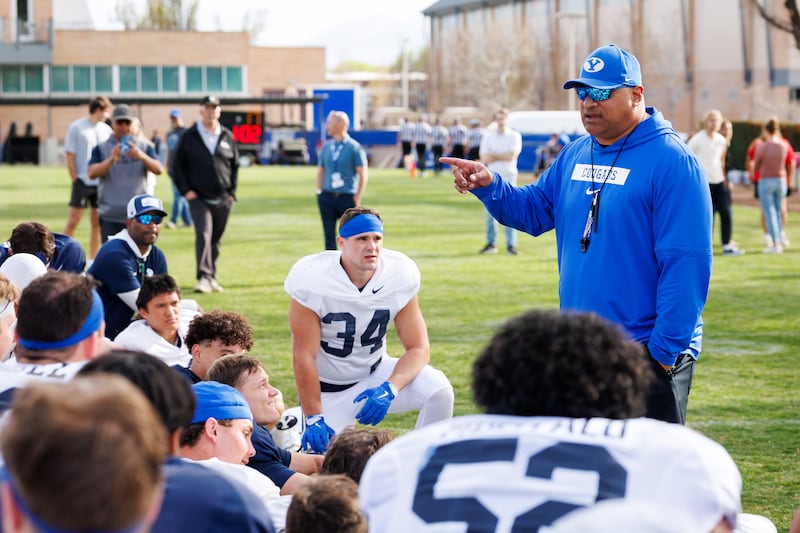

Kalani Sitake has spent the better part of a decade proving that culture, relationships and quiet persistence can still win in college football.
Over the past two seasons, those qualities helped deliver 23 victories and a preseason Top-15 ranking for 2026. What makes the run remarkable is how much of it was achieved while Sitake was repeatedly asked — and often told — to do more with less.
From the day he arrived, Sitake set out to assemble a staff that understood BYU’s unique demands. He wanted Sione Po’uha immediately and has continued to add coaches almost exclusively through former teammates, players and trusted connections who already grasped the program’s culture.
The latest wave — Jay Hill as defensive coordinator, Kelly Poppinga, Justin Ena, veteran offensive-line coach TJ Woods and an NFL-experienced tight-ends coach — has sharpened game preparation, teaching and consistency.
He’s now shifted gears by elevating Poppinga while keeping his offensive staff in place.
Culture remains the foundation. Sitake has blended his easygoing nature with genuine accountability, teaching players to compete for something larger than themselves, honor teammates and respect opponents. He leads with joy — grand entrances, dancing, thanking road fans who travel to watch the Cougars — and expects the same commitment from his players. The result is a locker room that still believes the team comes first.
That belief has been tested by the physical realities of power conference football.
Drawing on his years at Utah during the Utes’ climb from the Mountain West to the Pac-12, Sitake pushed for better training, nutrition, facilities, academic support and roster depth. After moving to BYU, he brought in Skyler Mayne to overhaul strength and conditioning; the staff now includes Ryan Phillips, Nate Pototschnik, Christian Tupou, Tim Ismail, Zach Shaw and former player Coleby Clawson as assistant athletic director for football health and performance.
Soft-tissue injuries that once were a huge problem have declined sharply. Analysts and consultants, including former head coach Gary Andersen, have been added for extra eyes on film and game planning.
After signing his new contract, Sitake gave Andersen the title of chief consultant to head coach/senior defensive consultant and elevated Po’uha to Associate Head Coach. Such title changes rectify raises in the football world.
The transfer portal and NIL era presented new fronts. Sitake and his staff identified fits that have pure talent, landing linebacker Jack Kelly and tight end Carsen Ryan, both drafted this past spring. His 2026 recruiting class ranked 21st in the country — the highest ever.
Lately, Sitake has sold players on a broader vision: NIL money matters, but so do roster chemistry and financial knowledge for the long term. Campus business experts help athletes manage taxes, portfolios and the power of compounding. That approach helped persuade nearly every starter from the 12-win 2025 team to return even when they could have made more money elsewhere.
Continuity, more than any splashy NIL, was much of the reason for the success in 2025 and great foundation for 2026.
All of it is rooted in Sitake’s unapologetic love for BYU. He has said repeatedly — and without guile — that coaching the Cougars is all he has ever wanted.
I saw his father, Tom, at the Utah Open Pro Am Monday at Riverside Country Club in Provo. He was camped out at a Polynesian food truck at the junction of holes 4, 11 and 17. I probed him about the current goings-on. He repeatedly said, “Kalani loves BYU. Kalani loves BYU.” Nothing more.
When Penn State came calling last November, Kalani stayed after receiving assurances that the program would have the resources needed simply to stay competitive, not to match the blue-bloods or oil-money programs. He has never asked to be a leader on the college football Yellow Brick Road; he only wants enough fuel to stay on the path and keep within striking distance of the lCFP leaders.
That promise is now the cause of some public friction.
Sitake’s agent, David Dunn, has spent years pressing for the contractual commitments signed last December. The university’s shortfalls are real, the product of a campus culture in which individual fiefdoms are guarded passionately.
As one observer noted recently, “Control is the wrong thing to optimize for. Output is. The people worth empowering are the ones trying to give power away, not collect it.”
The current drama is an unnecessary distraction on the eve of a promising season. It in no way erases the work Sitake has already done — building a staff, a culture, a healthier roster and a returning core that has delivered success.
There is still a way to fix it.
It’s not complicated. Contracts need to be honored. And on time.
If promised money was dumped in one bucket and not the other, more money needs to be collected to make it fair.
The question is whether the people who hold the keys are prepared to turn them.
