
With each passing day, the conversation about Major League Baseball expanding by two franchises within the next few years grows louder and louder.
On Tuesday, ESPN MLB insider Jeff Passan — arguably the most expert baseball reporter in the country — took a huge swing at the topic, as a long analysis of six potential expansion cities was published, as well as an episode of his podcast, “Sources Tell Jeff Passan,” in which he spoke to someone from each of the six markets who is helping bring MLB to their respective cities.
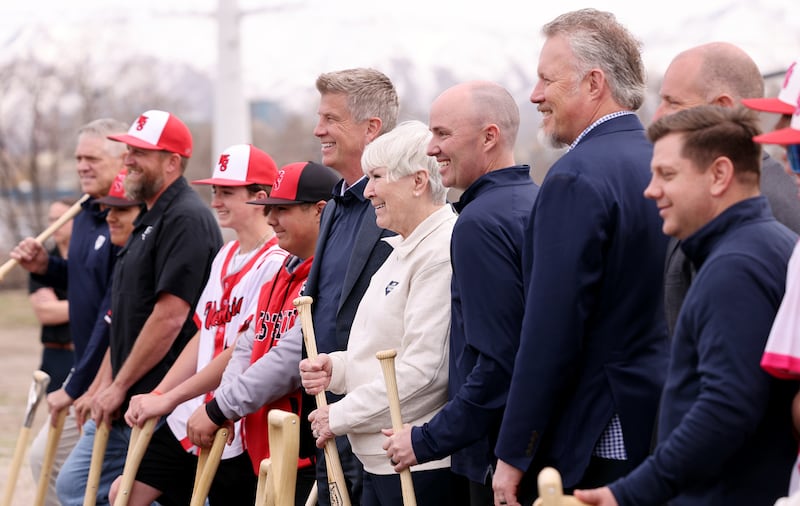
The first guest on the podcast, representing Utah’s efforts led by the Larry H. Miller Company, was the state’s governor, Spencer Cox, who is also an adviser to Big League Utah.
Passan and Cox spoke for just under 10 minutes. Here are some highlights from their conversation.
In introducing Cox and the Salt Lake City portion of the podcast, Passan said, “Money talks — always — and it’s why we chose to start with our first city. It’s got strong ownership, it’s got an ambitious stadium site already being developed and it’s got a governor willing to stump for it.”
Noting that Cox signed a bill in 2024 that would set aside up to $900 million in public financing for an MLB stadium and that he was Utah’s governor when the Utah Mammoth came to town that same year, Passan asked Cox why Utah is the right place for Major League Baseball.
“Look, Utah has been preparing for this day for a long time,” Cox said. “We like to refer to ourselves as the state of sport. We care deeply about sports here, and we care deeply about community and building community doing it the right way.”
Without naming specifics, Cox noted some of the recent scandals that are going on right now with owners of sports franchises (Steve Ballmer of the NBA’s LA Clippers and Mark Walter of MLB’s Los Angeles Dodgers, who just sold the Los Angeles Lakers after a short stint) and said, “We truly believe that we’ve got the right team here in Utah.”
Providing some history about how Larry H. Miller bought the NBA’s Utah Jazz in the mid-1980s and how the Winter Olympic Games were in Salt Lake City in 2002, Cox told Passan that the Beehive State is ready for another big sports franchise.
“That’s when things really started to change,” Cox said of the Olympics.
Cox also touted Utah’s economy and the Miller Company as the ownership group as other reasons he feels there should be an MLB team in Salt Lake City.
“The whole community together — Republicans, Democrats — we all believe in this,” Cox said.
Passan then asked Cox to draw upon his experience as the Mammoth were relocated from Arizona to Utah to share what he felt were important elements for a city to make a convincing pitch for a new major sports franchise.
“You have to have your stuff together,” Cox said, giving credit to current Jazz and Mammoth owner Ryan Smith as well as the Miller family for having the desire to build community in Utah through sports.
“You’ve got the people who are devoted and committed to a place, but you need the groundswell of support as well. You need the citizenry to want this, and that’s what we have here.”
Noting that he works closely with Salt Lake City Mayor Erin Mendenhall on this issue, Cox said, “In a very polarized country, sports is something that brings us together, and we’re really proud of that but we also have a vision for what this could look like and should look like, and that happened with the Mammoth.”
Speaking on the Mammoth’s community success so far, Cox said, “It just proved that Utah is the type of place ... that we can support multiple professional leagues.”

Passan did push Cox on the notion that Salt Lake City is a smaller media market than both Portland — Utah’s primary challenger in the West for an MLB expansion team — and Sacramento, which has been hosting the former Oakland Athletics as that franchise transitions to Las Vegas.
Cox replied that, “So far it hasn’t been much of an impediment at all” and pointed out that the “Salt Lake City market” encompasses the entire state. He also noted that Utah would be far from the smallest market in MLB, and indeed, Baltimore, San Diego, Kansas City, Cincinnati, Milwaukee and Las Vegas are smaller television markets.
Additionally, he pointed out that there has to be a fanbase within the market that cares, “and that’s where Utah exceeds many of these other places. Again, we’ve proved that over and over again with the Mammoth. We’ve proved it with the Utah Jazz, where the numbers ... are all more on par with a larger market, and I think that’s one of the things that makes Utah really unique and really fascinating.
“It’s why we’ve gotten so much attention. I know it’s why (Major League Baseball) is looking very seriously at us.”
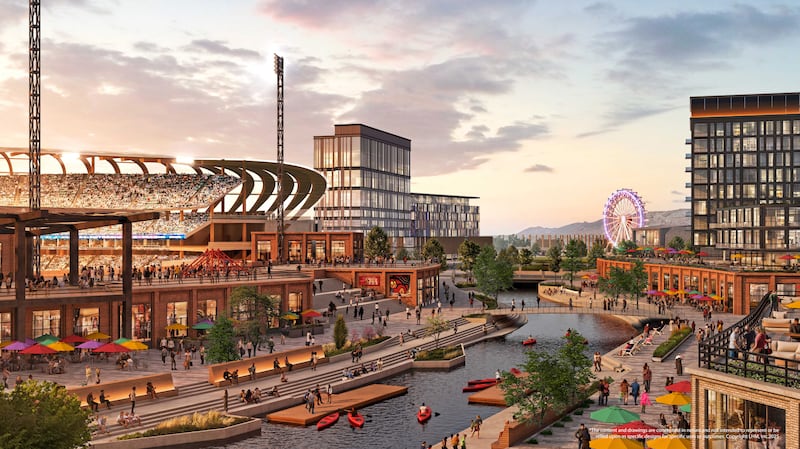
Cox then emphasized, “We’ve already done the thing that is the hardest part to do” in identifying a site and making plans for a stadium.
“We already did this. We did it a couple years ago,” Cox said. “I mean, we’re so far ahead of this, the Miller Group is designing the actual stadium right now. ... We know what this is going to be. We know what this is going to look like, and it’s going to take other municipalities and other states a long time to catch up on just that piece alone.”
The last concern Passan raised to Cox was about the drying up of the Great Salt Lake and the potential environmental impacts of building and having a stadium in Salt Lake City (the plan would be to have the stadium on the city’s west side).
“The good news for everybody is that same model that has led us to be ahead of the game when it comes to Major League Baseball is actually happening with the Great Salt Lake,” Cox said.
“It’s incredible to see the way that people are working together to solve this problem in a bipartisan way and nonpartisan way.”
Cox noted President Donald Trump’s pledge of $1 billion to help refill the lake and said the lake should be at a record low this year but is not because of the efforts that have been taking place to refill it.
To end the interview on a much more lighthearted note, Passan asked Cox what his favorite soda is and whether or not there would be a “wide range” of dirty sodas at Utah’s ballpark should a Major League Baseball team arrive.
“I will be very clear there will be a wide range of dirty sodas available. We’ve already had those conversations. Those are the important ones,” Cox said. “I hope that doesn’t make it into the name of the team. We can do better than the Dirty Sodas.”
Passan jokingly pushed back, to which Cox said, “Maybe not. It’s one of our greatest exports right now.”