


Just six weeks after a collision on the football field left him paralyzed, Harrison Taggart can walk again, but not run, and he rarely uses a wheelchair. During daily half-mile strolls with his mother around his parents’ Draper neighborhood, he uses a cane occasionally, especially where the ground is uneven. He undergoes daily rehab sessions. He began to drive again two weeks ago.
Slowly, he is regaining his old life, but how much of it remains to be seen. He will not play football again this season — or maybe ever.
It’s ironic — here is a 6-foot-1, 230-pound DI college linebacker who was bench-pressing 400 pounds and squatting more than 500 pounds, and for a time he couldn’t lift his hands. He is having to learn the simplest tasks — walking, sitting, standing, dressing himself, climbing stairs. Only a few weeks ago, he was running all over the football field, collecting 18 tackles for Utah State in a little more than two games. Now he struggles to negotiate stairs.
The collision
Taggart was injured during a game against the University of Utah on Sept. 19. Midway through the second quarter, he dived into the legs of running back Daniel Bray. It looked routine, no different than the hundreds of tackles he had made over the years, but when the play was finished he lay inert on the turf. The other players got to their feet, but not Taggart.
The best guess is that when Taggart’s head collided with Bray’s knee, he was knocked unconscious. In that split second, as he puts it, “I was knocked out so I had no control to stop my neck from going farther over (down and to the side) than it should.”

His condition is known as transient neuro quadriplegia, a temporary, reversible spinal cord injury “caused by sudden compression, hyperextension, hyperflexion or axial loading of the cervical spine.”
Later, observers would wonder how he moved his legs restlessly as he lay on the turf and moments later raised a hand to the crowd, but the swelling had not yet built up in the spinal cord. That would change soon.
An ambulance drove onto the field. Taggart’s sister, Maddy, a hurdler on the BYU track team who had made her way down through the stands to the field, jumped into the front seat of the ambulance. She watched and listened through the small window as medics treated her brother.
“He was fully alert,” Maddy recalls. “He was joking with the medics and he was in and out of freakout and panic. At the hospital he was crying and very emotional. We went into the trauma room and they cut off his uniform. They told him to move his ankle and he said, ‘I am!’ They asked him again to move his ankle and he said it again, ‘I am!’ There was no movement.”
Taggart’s father, Ryan, and the Utah State medical staff prayed together in the emergency room.
‘I couldn’t move anything from the neck down’
Taggart remembers none of this — or anything from that day — until he woke up in the tunnel of an MRI machine several hours after the injury occurred. The MRI lasted an hour and 45 minutes; Taggart regained consciousness and called for help.
“I couldn’t move anything from the neck down,” he says. “My fingers started to twitch, pain shot down my arms and back. I had no strength to squeeze the little ball they put in your hand. I was crying for help, but they couldn’t hear me. Finally, the lady said, ‘Sorry honey, you’ve got five minutes. Are you OK?’”




Late that night, feeling began to return to his upper body and there was slight movement in his toes, but otherwise he was paralyzed below the waist. By Sunday morning, he was able to move his feet and legs and stand with assistance. On Monday, he walked for the first time, a few shaky steps at a time, aided by a walker and strapped to a therapist. By Tuesday, he was able to walk into the lobby very gingerly to greet family and friends.
Taggart progressed so rapidly that he was released to outpatient rehab at Neuroworx in Sandy, where he did an hour of physical therapy and an hour of occupational therapy each day.
It consisted of walking on land and in water, walking while catching a small ball, walking stairs and over small hurdles, working on a balance board, lying on the floor and getting up on his own, cornhole games, sitting and standing, putting on socks and shoes, etc. The rehab program was supposed to take six weeks, but after two weeks, Neuroworx therapists said he was ready for the next step.
‘I forced myself to get better’
“I was super stubborn,” says Taggart. “If my body wasn’t letting me do something, I’d go home and practice and force myself to do it. I forced myself to get better. They told me, ‘There’s nothing else we can do for you.’ They passed me off to a clinic that focuses on the brain. My software — my brain — needed to be rewired to hook up again with my body.”
“They said if I weren’t as fit and strong and flexible as I am, it would have been a different outcome. They said I was a centimeter away from being a quad.”
— Utah State linebacker Harrison Taggart
He still feels pain below the waist and tingling throughout his body, which doctors say he likely will experience for the rest of his life. His strength, coordination and balance are improving.
A follow-up MRI late last week brought good news. “It came back clear,” says Taggart. “The concussion (to the spine) healed. Already. The doctors and surgeons told me that I’m lucky. Usually when someone has the neuro trauma that I had, they die or end up on life support.
“They said if I weren’t as fit and strong and flexible as I am, it would have been a different outcome. They said I was a centimeter away from being a quad.”
Since the injury, Taggart has received an outpouring of support. Morgan Scalley, the Utah head coach, was one of the first people to visit him in the hospital. USU’s entire defensive staff showed up at the hospital.

Shane Hunter, USU’s linebacker coach, walked from the stadium to the University of Utah hospital after the game while the rest of the team bused back to Logan and remained there until 10 that night (his wife drove from Logan to join him).
USU’s entire PT and orthopedic staff stayed behind as well. USU coach Bronco Mendenhall was there to witness Taggart’s first steps. BYU coach Kalani Sitake visited and offered a prayer with Taggart.
‘Nationwide support’
“We had nationwide support,” says his mother, Holly. “We learned that church congregations from all denominations around the country offered prayers for him. Some missionaries texted and said they knelt in the middle of the road to pray for him.”
BYU was playing Colorado State on the road that night. As players and coaches held team meetings that day, waiting for their game, they had TVs on in the room showing various games from around the country. When Taggart went down, a former BYU teammate texted him that they had stopped the meeting and said a prayer for Taggart — “We’re praying for you, buddy,” he said.
“We learned that church congregations from all denominations around the country offered prayers for him. Some missionaries texted and said they knelt in the middle of the road to pray for him.”
— Holly Taggart, Harrison Taggart's mother
On Taggart’s birthday, his mother wheeled him downstairs and into the dark night outside, where he was greeted by 30-40 teammates holding signs and cheering. They hugged him. They gave him candy. There wasn’t a dry eye anywhere.
Taggart sobbed as soon as he saw them. His teammates had driven two hours from Logan after a full day of class and practice, knowing they had a weightlifting session the next morning at 6.
“We should say a prayer,” said Nick Howell, the defensive coordinator. Linebacker Bronson Olevao offered the prayer as the team gathered tearfully arm in arm. “It was the most beautiful prayer,” says Taggart.
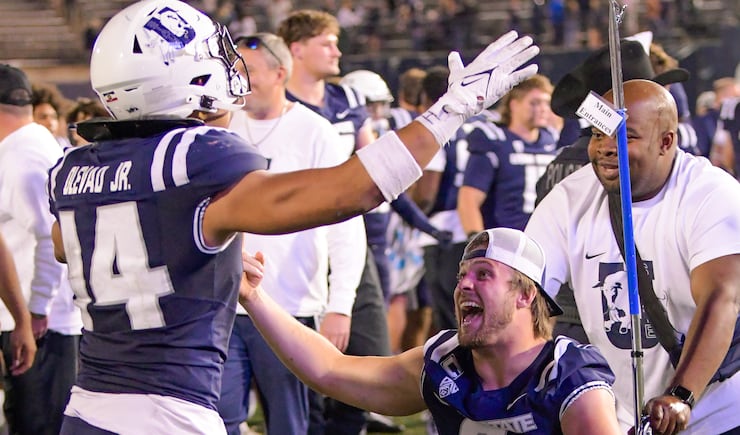
One week after the injury, Taggart showed up at the team’s home game against Troy State. He was pushed in a wheelchair to midfield with the team captains and stood briefly, holding the hand of teammate Brevin Hamblin during the coin toss. He celebrated with his teammates after the team secured its first win of the season.

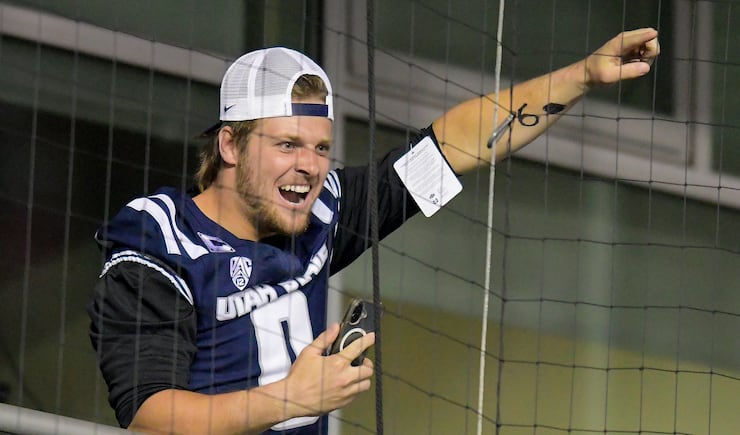
Taggart drove to Logan to watch practice, and he traveled with the team last weekend for a game against Texas State. He stood on the sideline in the first half, providing teammates with energy snacks and coaching them on things he noticed on the field.
In the second half, his legs began to falter and he had to use a wheelchair. The long plane ride home further aggravated his legs “to the point that they felt like they did my last day in the hospital. It was miserable. I had to get help out of the plane and to the bus. It was crazy.”
What now?
The sideline is perhaps as close to the action as he’ll ever be again. Taggart’s neurosurgeon told him that he wouldn’t play football this season — or ever again. Taggart sought a second opinion and wound up changing doctors.
“I love football,” he says. “There’s nothing like it. From the work ethic to the relationships to the life lessons. I’ve worked for this since I was 10. To have someone tell me I’ll never play football again was hard to hear. (The new neurologist) didn’t say I can, only that it’s a possibility.”
His sister calls this idea “fairly insane,” and Taggart himself wonders if he could return to the game even if he were cleared by doctors.
“There’s the mental side of it,” he says. “You go through all that trauma and tears and you can’t move and the doctors saying you can’t play again. My body will be good, but the mental part of things … I play recklessly, with my head. I play hard, I hit hard. How will I play like that after being paralyzed?”
“I love football. There’s nothing like it. From the work ethic to the relationships to the life lessons. I’ve worked for this since I was 10. To have someone tell me I’ll never play football again was hard to hear. (The new neurologist) didn’t say I can, only that it’s a possibility.”
— Utah State linebacker Harrison Taggart
There’s another problem; his eligibility expires this season, meaning he would have to appeal to the NCAA for a sixth year.
Taggart has been searching for a home since he was a four-star recruit at Corner Canyon High in 2022. He has played for four universities in five years — Oregon, BYU, Cal and Utah State.
He left Oregon after head coach Mario Cristobal assured him during a home visit that he would never leave the school — and then went directly to Miami. Taggart had two productive years at BYU — he was the team’s second-leading tackler in 2024 — and drew interest from NFL teams, but he transferred again because of “in-house politics.”
He left Cal after another coaching change, one that resulted in his former Oregon coaches coming to the school. He decided to move home again, this time to USU. Now his future is uncertain.
The first thing a visitor sees as he enters the Taggart home is a large framed USU jersey leaning against the wall — “The jersey I was wearing when I almost died,” he says. The jersey bears the battle scars — three places where scissors cut it away from his body.
Time will tell if he ever wears a jersey again.
