

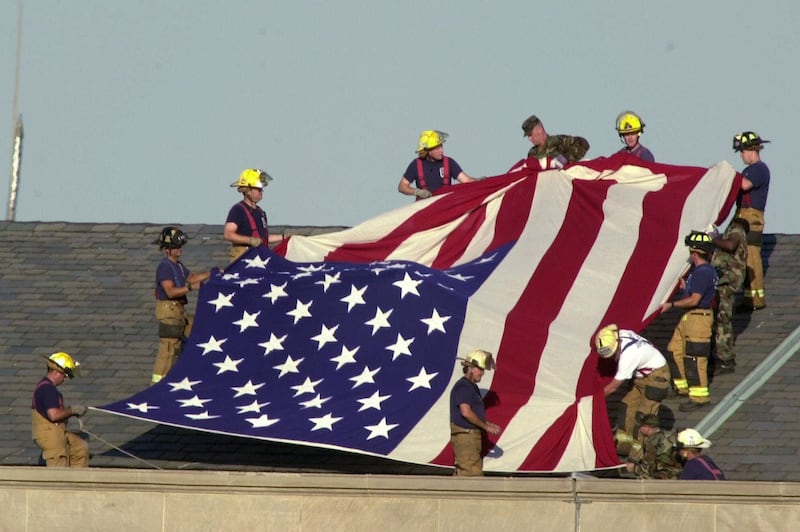

The morning of Sept. 11, 2001, began for millions as a typical Tuesday, an ordinary day like so many other ordinary days. But within hours, nothing would ever be ordinary about 9/11 again.
Ordinariness would evaporate and get replaced by chaos, fear and uncertainty not just at the World Trade Center in New York City, but everywhere else in the country, too.
Two airplanes piloted by terrorists struck the Twin Towers that day, causing them both to collapse. One more airplane struck the Pentagon building while passengers on a fourth plane — United Flight 93 from Newark bound for San Francisco — courageously commandeered the plane before it crashed in a field in Pennsylvania.
Tragically, it is estimated that 2,977 Americans died that day from these terrorist acts.
James Dowdell’s father was one of them.
Remembering a hero dad
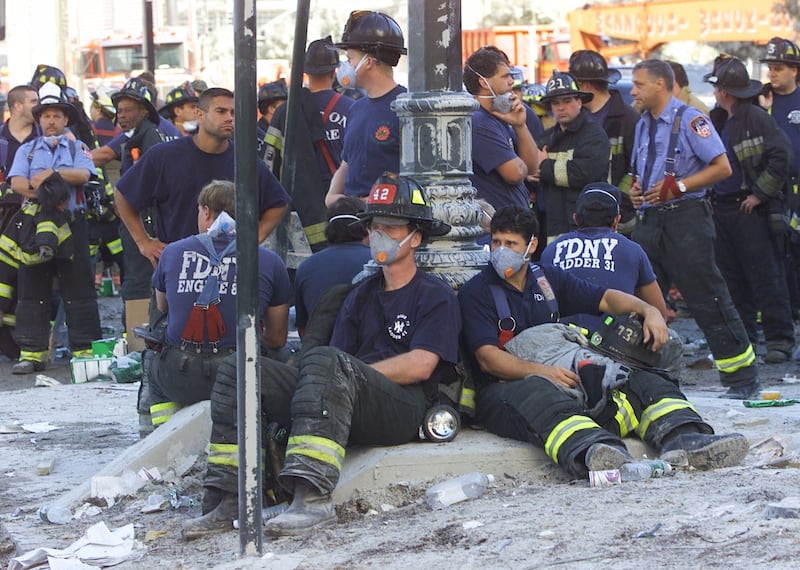
James is a New York City firefighter at Rescue 4, the same unit his father was in 25 years ago when he responded to the Twin Towers attack on 9/11.
“All of the guys who survived that day who worked with my father are retired now,” James told me. “But I still go to breakfast with the guys who are (around). It’s good to be with the guys. Later, we go to Mass and are reminded that we are all God’s children.”
James spoke about both communal remembrance and collective action moving forward. He said it is as important to remember the day after 9/11 when people came together around the country as it is to remember the previous day’s tragedy.
“Despite all of the uncertainty following 9/11, people made a point of looking out for each other the following day,” he said. “For sure, 9/11 was a tragedy, but it is also important to remember the everyday heroics that came during the days after it, too.”
Twenty-five years after Sept. 11, 2001, the challenge for the nation is not only to “Never Forget” what happened on 9/11 but to also remember “Coming Together” so that triumph defines us more than tragedy.
As President George W. Bush and others have suggested, Sept. 12 should be a “National Day of Encouragement.”
The physicality of remembrance
At Utah State University’s Maverik Stadium, 9/11 has become a place where both the tragedy of 9/11 and the promise of 9/12 are kept alive in a very intentional — and physically demanding — way.
Each year, firefighters and community members participate in a 9/11 Memorial Stair Climb that is not only a memorial service but also a physical expression of resolve for the 343 firefighters who lost their lives that day in New York City.
As thousands fled down the stairwells of the World Trade Center on 9/11, firefighters carrying heavy gear were moving the other direction — climbing toward the fire and those who remained trapped above. Many of these first responders were still making that ascent when the towers collapsed.
The USU community event is a way for those who join in to remember the past and look forward to making a difference in the lives of others in the future.
“It starts with what we choose to remember,” said Rhett Hellstern, emergency management coordinator for USU Public Safety.
The event, now a cornerstone of the university’s calendar, started small. Initially, Logan firefighters used the stadium stairs simply to stay in shape. However, as they tracked their progress, someone noticed that climbing every single stair section across the entire stadium came remarkably close to the 2,071 steps of the Twin Towers.
The stair climb soon became a way to honor fallen fighters from 9/11.
“When people physically feel a small piece of what those firefighters did, it tends to produce gratitude and humility rather than anger,” Hellstern explains. This year the community is invited to join the firefighters on 9/11 at Maverik Stadium to climb the stairs with them.
Since the climb is roughly equal to the 110 stories of the Twin Towers, it is a way to honor the firefighters who lost their lives in service by renewing a commitment to serve each other in the community.
The brotherhood of the badge
Bart Walker, a 66-year-old veteran firefighter with 43 years of service in Payson, Utah, goes to the Tech Ridge Stairs in St. George to join with others in climbing stairs and think about simple ways he can serve others, step-by-step, in his community.
“For me, it’s all about being part of the firefighter brotherhood while extending it to others,” Walker said. “This is the way I can show my support for the 343 FDNY firefighters that paid the ultimate price that day. It is also a way to be associated with other firefighters and volunteers across the nation with the same mindset.”
Walker often performs the stair ascent in full gear, including wearing the heavy Self-Contained Breathing Apparatus (SCBA), which adds 60 pounds of weight and restricts deep breathing — a stark reminder of the conditions faced in the stairwells of Lower Manhattan.
Walker recalls how, in 2001, the country seemed to rally together for the greater good after the terrorist attack.
“People were more patriotic, with more flying the flag, enlisting in the military, and helping their neighbors,” he said. In these times of political and social division, he hopes the stair climb will remind people that there is much more that unites us than divides us.
Bridging the generational gap
One of the most pressing concerns for organizers like Hellstern and veterans like Walker is the “generation gap.” For college students today, 9/11 can seem like merely a historical event — since they didn’t witness it.
To prevent the day from just becoming another entry in an American history textbook, USU organizers use tangible symbols. Each participant in the Maverik Stadium climb carries a lanyard featuring the photo and biography of one of the 441 first responders — firefighters and police — who perished that day. This transforms a faceless statistic into a specific human life, carried step-by-step by each participant.
Organizers also feature the names of the people who died that day from the attack at the stadium. “Walking past the names of all 2,977 people who died that day, and reading facts about the events of that morning, gives younger participants a chance to connect with history in a way that sticks with them,” Hellstern says.
Bart Walker agrees that visible reminders help ensure that even the youngest participants understand the significance of the day — turning abstract dates into tangible ways to remember and apply lessons learned.
The legacy of Sept. 12
The ultimate goal of the “Never Forget” mantra associated with 9/11 — and other historical tragedies, including the Holocaust — is to recapture the spirit of the days that followed the attacks: the “Sept. 12” feeling, where political and social divisions faded in favor of deliberate and positive communal action.
This legacy is perpetuated through small, personal acts, like an “empty chair” tradition kept by the family of James Dowdell, who leaves his father’s chair vacant during dinner on 9/11. The family then joins planned community service activities the following day.
“I hope we can remember 9/12 and the days that came afterward by doing something for others as much as we remember 9/11 — maybe looking around for ways to show more kindness,” Dowdell emphasized during our interview.
This sentiment may be the most important step climbed from St. George to Logan and places in between. The best way to honor those whose heroic acts enormously benefited others is not to hunker down in the shadows, but instead boldly go forward with purpose — linking arms with diverse members of our communities.
By carrying the weight of the past — one step, one story, and one act of kindness at a time — we create a legacy and a future worth living for.