

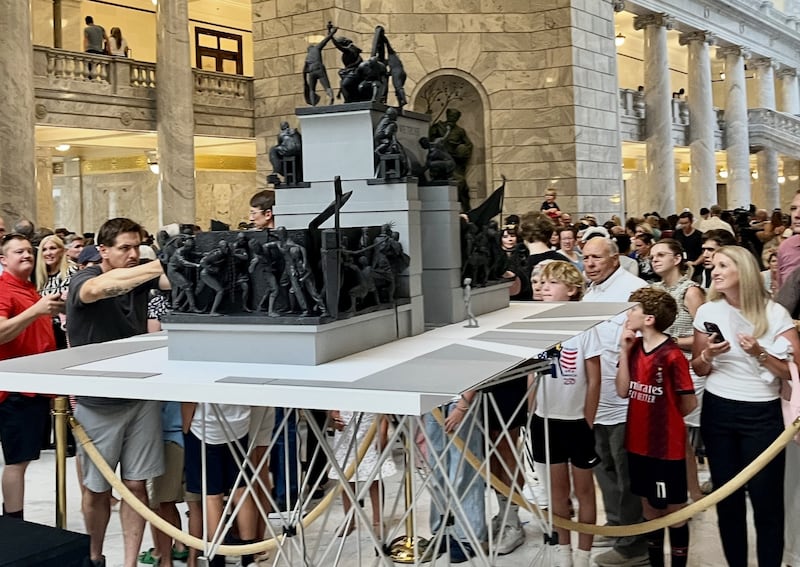
The artist behind a 60-foot arch aimed at celebrating the history of U.S., proposed to be built near the Utah Capitol, said he is pursuing a new location following neighborhood pushback.
Sabin Howard, the artist behind Grand Liberty Arch, wrote that the proposed site near the Utah Capitol is “not the right home for a project of this scale,” in an opinion piece published by Deseret News Tuesday evening.
“I imagined a place where parents might bring their children and teachers their students; where visitors could encounter our history, read words from the Declaration of Independence and Constitution, and consider both the freedoms we inherited and the obligations that accompany them. That vision requires room to breathe,” he wrote, in part.
“So, the Grand Liberty Arch will continue its search for a home, and (my wife) Traci and I will continue our journey,” he continued, noting that he plans to relocate out of the state in the pursuit of building the sculpture.
The letter was also reportedly sent to the Capitol Preservation Board. It was published a little more than a month after a model of the sculpture was unveiled at the Utah Capitol, as part of America 250 celebrations during the Independence Day weekend.
The sculpture depicts many elements of the past 250 years in the U.S., ranging from the Revolutionary War and the signing of the Declaration of Independence to its westward expansion, and other pivotal moments.
Howard, who recently completed a World War I memorial in Washington, D.C., and who moved to Utah last year, said the project was originally envisioned for This Is the Place Heritage Park. But that changed to the Utah Capitol, which could provide a “larger audience.”
Members of the Capitol Preservation Board, including Gov. Spencer Cox, signed off on the project in May, with the expectation that the estimated $55 million project costs would come from private donors. It was anticipated to be built by the end of 2033, in place in time for the 2034 Utah Winter Olympics and Paralympics.
“For two and a half centuries, liberty has been an active ingredient in the background of American history, and the driving engine of our national progress,” said Rep. Mike Kennedy, R-Utah, last month, adding that he believed the sculpture would capture that story.
However, nearby residents weren’t as thrilled. Residents of Salt Lake City’s Capitol Hill neighborhood rallied against the proposal, voicing concerns about traffic and impacts to available green space.
The Capitol Preservation Board planned to build the monument on a parcel across the street from the main complex, known by some as the Capitol triangle. That would force visitors to cross the street to view it, potentially snarling traffic along Capitol and Columbus streets, some residents argued.
Among other concerns, it would also take up most of the space that residents use for gatherings or quieter uses away from the Capitol complex, Jonathan Bruns, chair of Capitol Hill Neighborhood Council, said in July.
Bruns told KSL on Tuesday that he’s relieved to hear the project is not moving forward in that location.
“I can’t really articulate how thankful I am for the neighbors we have and the assets we have in our community to kind of come together and speak so clearly about this,” he said.
Rep. Jennifer Dailey-Provost, D-Salt Lake City, and Salt Lake City Council Member Chris Wharton, the neighborhood’s legislative and municipal representatives, also lauded Howard, crediting him for listening to residents and deciding to relocate the piece.
“As residents began raising concerns, it became clear that the approval process for the arch must be improved by ensuring robust community engagement and feedback,” they said in a joint statement on Tuesday.
“It is important to the integrity of our neighborhoods that people are given a meaningful voice in decisions that will shape the community for generations,” they added. “Capitol Hill community members spoke up because they love this neighborhood, its history, its green space, its trees and the architectural character that makes it unique.”
It’s unclear where the sculpture will be built, as Howard and his wife search for a new location.
He wrote that he’s still grateful for his time in Utah and the experience, which he tied to the sculpture itself.
“We can disagree about a monument. We can disagree about history, art and the use of a particular piece of land,” he wrote. “A strong community does not require unanimity. It requires people who care enough to participate, the freedom to disagree and the grace to remain neighbors afterward. That, too, is part of the American inheritance worth preserving.”
Contributing: Brittany Tait